
A Congress reshaping Europe
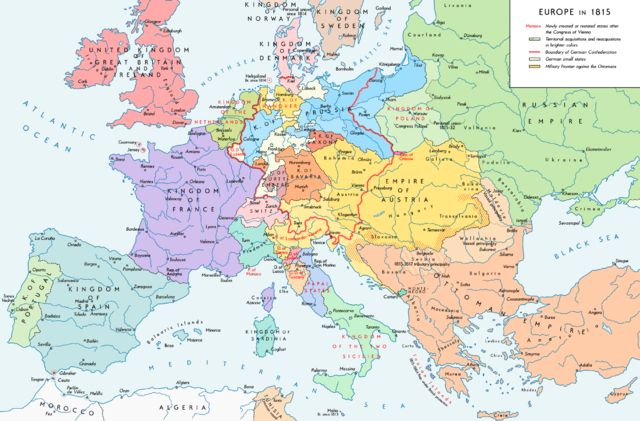
The Congress of Vienna was one of the most important diplomatic gatherings in European history. Held from November 1814 to June 1815, it focused on restoring order after the Napoleonic Wars. Although Napoleon still posed a threat during the Congress, Europe’s leaders and diplomats met in Vienna to shape the continent’s future once he was fully defeated.
One of their main tasks was to redraw the map of Europe. Napoleon had conquered and reorganized much of the continent, so it wasn’t possible to simply return to the pre-war borders. Instead, the Congress reshuffled territories, transferring large areas between countries, merging and splitting regions, and even creating entirely new states.
Another major issue discussed during the Congress (and in its aftermath) was the question of constitutions. Many states had undergone significant changes under Napoleon’s rule, so leaders agreed that new rules were needed to define how these countries should be governed. These constitutions often addressed religious freedoms and the rights of minorities.
A key topic of debate was whether religious minorities—especially Jewish people—should have the same rights as the majority. Napoleon had already expanded Jewish rights in areas under his control, so many leaders were now forced to consider whether those reforms should remain.
One lasting result of the Congress was the formation of the Holy Alliance, a union between the rulers of Russia, Austria, and Prussia. This alliance aimed to protect Christianity and uphold the divine rights of monarchs, particularly against liberal or secular movements. Interestingly, while all three rulers followed different branches of Christianity—the Russian Tsar was Orthodox, the Austrian Emperor was Catholic, and the Prussian King was Protestant—they united around their shared commitment to preserving traditional values.
What was the main purpose of the Congress of Vienna, and what were some important issues the leaders discussed?