
The German Constitution on tolerance
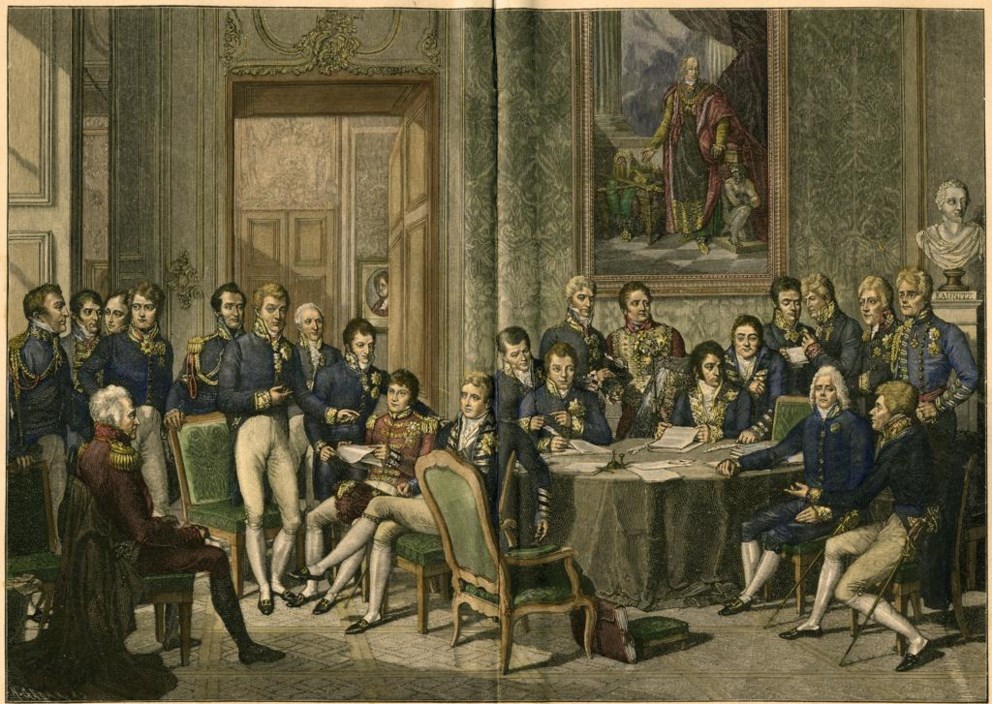
The Congress of Vienna also tried to write a new German Constitution. One draft version of 1815 contained the following clause:
‘The Jews will, as long as they take up all citizen duties, have the corresponding citizen rights. Where state constitutions stand in the way of this reform, the members of the new German confederation say that they want to remove these obstacles as much as possible.’
Context:
The Congress of Vienna was a diplomatic meeting of the highest level. Formally held between November 1814 and June 1815, it dealt with the end of the Napoleonic Wars. Although Napoleon still formed a threat during the Congress, Europe’s leaders and their ambassadors determined in Vienna what Europe would look like after he had been defeated. The Congress dealt with a number of issues. First and foremost, the map of Europe needed to be redrawn. Before 1814, Napoleon had conquered much territory for France and changed how these lands were ruled. So much so, that the delegates at the Congress could not simply go back to what Europe had looked like before Napoleon. Therefore, the diplomats in Vienna switched large pieces of land between countries, merged and divided other countries, and even created some brand-new countries. Another important matter discussed during or in the wake of the Congress was constitutions. Many of the new and old states had changed so much under Napoleon that it was deemed better to set some rules about how they should be governed. In many cases, these new constitutions also dealt with the religious differences of people. There was a lot of debate in Vienna about the rights of religious minorities – could they be granted the same rights as the majority? This applied especially to the Jews, who were a minority in many countries. This debate about the Jews was extra important because Napoleon had already given them more rights during his rule over Europe. Another consequence of the Vienna Congress was the creation of the Holy Alliance between the rulers of Russia, Austria and Prussia. The Alliance aimed to defend Christianity and the divine rights of monarchies, mainly against liberal and secular reformers. The alliance had Christianity as one of its centerpieces, although the Russian Tsar was an Orthodox Christian, the Austrian Emperor a Catholic, and the Prussian King a Protestant.
What do you think of these principles? Are they a good basis for religious tolerance?
For more information on this and other peace treaties, see