
The Edict of Saint-Germain: Places and buildings
The Edict of Saint-Germain arranged the places and buildings where Protestants could worship. It also contained many prohibitions. Buildings that Protestants had used, taken or received from Catholics in the previous years had to be given back. In the city of Valence, for example, Protestants had used the courtyard of a convent up to 1562. At the same time, the Catholic friars had still resided there. After 1562, the edict allowed Protestants to worship only outside of the city walls. Celebrations and preaching in cities were strongly forbidden for Protestants. Discussions and conflicts about where Protestants were allowed to worship continued after the Edict. In fact, they were one of the main causes of the outbreak of the first war of religion in France between 1562 and 1563.
The Edict of Saint-Germain (1562) was a piece of legislation issued by the French king. It gave Protestants limited rights to worship in France. In previous decades, Protestantism had become popular in various parts of France. The French king, who himself was a Catholic, initially prosecuted Protestants. He considered deviations from Catholicism illegal. In spite of this prosecution, Protestantism continued to grow in France. Initially, Protestants gathered and celebrated in hiding. Over time, they also began to gather and worship in public. This created a tense situation throughout France.
The Edict of Saint-Germain sought to arrange peaceful coexistence between Protestants and Catholics. It gave them limited rights to worship outside cities. However, it met with opposition from Catholic nobles and judges, who considered it unacceptable to extend rights of worship to Protestants. Due to this opposition, tension continued. Protestants believed they were now allowed to celebrate publicly but at times were attacked nevertheless. They reacted by taking over control of the local government in various French cities. This led to the outbreak of the first French war of religion in the summer of 1562. For the next 37 years, religious wars and temporary pacification legislation followed one another.
According to you, how connected or bound is religious worship to particular places?
For more information on this and other peace treaties, see
Title
The Edict of Saint-Germain: Places and buildings
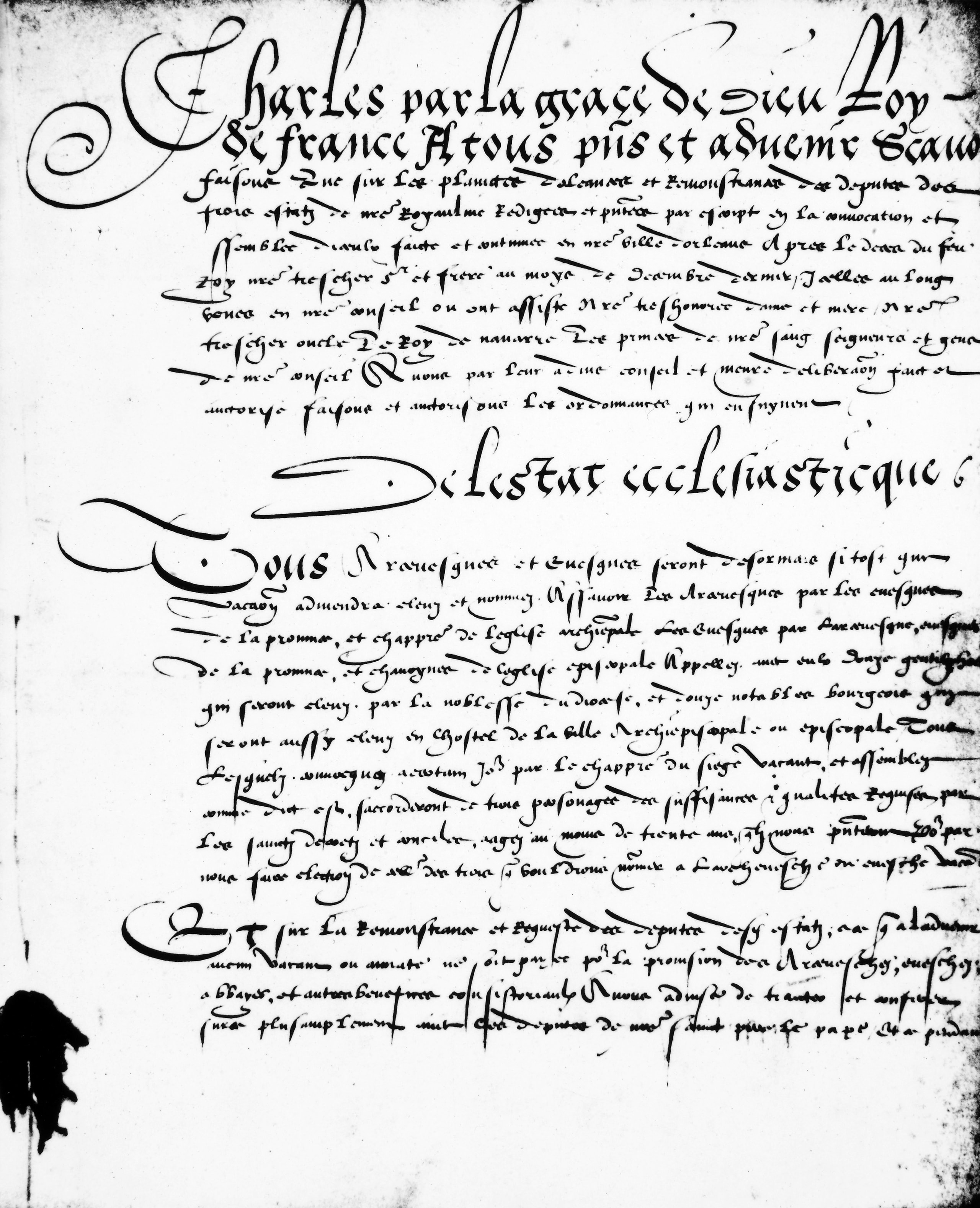
content
The Edict of Saint-Germain arranged the places and buildings where Protestants could worship. It also contained many prohibitions. Buildings that Protestants had used, taken or received from Catholics in the previous years had to be given back. In the city of Valence, for example, Protestants had used the courtyard of a convent up to 1562. At the same time, the Catholic friars had still resided there. After 1562, the edict allowed Protestants to worship only outside of the city walls. Celebrations and preaching in cities were strongly forbidden for Protestants. Discussions and conflicts about where Protestants were allowed to worship continued after the Edict. In fact, they were one of the main causes of the outbreak of the first war of religion in France between 1562 and 1563.
Description
This clipping discusses the role of particular buildings in creating and solving religious conflicts in France in the sixteenth century.
Context
The Edict of Saint-Germain (1562) was a piece of legislation issued by the French king. It gave Protestants limited rights to worship in France. In previous decades, Protestantism had become popular in various parts of France. The French king, who himself was a Catholic, initially prosecuted Protestants. He considered deviations from Catholicism illegal. In spite of this prosecution, Protestantism continued to grow in France. Initially, Protestants gathered and celebrated in hiding. Over time, they also began to gather and worship in public. This created a tense situation throughout France.
The Edict of Saint-Germain sought to arrange peaceful coexistence between Protestants and Catholics. It gave them limited rights to worship outside cities. However, it met with opposition from Catholic nobles and judges, who considered it unacceptable to extend rights of worship to Protestants. Due to this opposition, tension continued. Protestants believed they were now allowed to celebrate publicly but at times were attacked nevertheless. They reacted by taking over control of the local government in various French cities. This led to the outbreak of the first French war of religion in the summer of 1562. For the next 37 years, religious wars and temporary pacification legislation followed one another.
Questions
According to you, how connected or bound is religious worship to particular places?
Temporal Coverage
16th century
Spatial Coverage
Europe, France
map
48.8989 / 2.0938
Subject
Is Referenced By
Bibliographic Citation
Penny Roberts, The most crucial battle of the wars of religion? The conflict over sites of reformed worship in sixteenth century France., Archiv fur Reformationsgeschichte, 89, 1998, 247-267
Audience
Yes
Creator
Christophe Schellekens

