
Westphalian Peace 1648 – Paragraphs I and II, summary
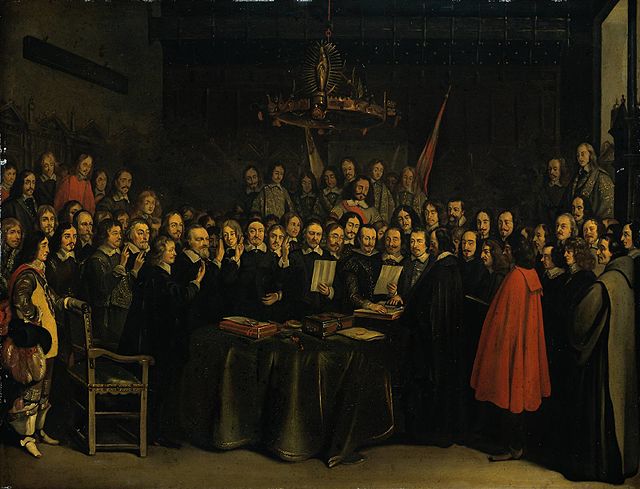
In the Münster Peace Treaty of 1648, the signing powers initially agreed on the general understanding of the peace. They considered best to start with an amnesty. This meant forgetting about everything what had happened during the war in order to facilitate a new, peaceful beginning. The first two articles read in the tortuous language of the time:
‘The following articles have been agreed on and consented to:
I. That there shall be a Christian and Universal Peace and a perpetual, true and sincere amity between all and each of the allies on the one side and all on the other part. That this Peace and Amity shall be observed and cultivated with such a Sincerity and Zeal, that each party shall endeavor to procure the Benefit, Honor and Advantage of the other; that thus on all sides they may see this Peace and Friendship in the German Empire and the Kingdom of France flourish by maintaining a good and faithful Neighborhood.
II. That there shall be on the one side and the other a perpetual Oblivion, Amnesty, or Pardon of all that has been committed since the beginning of these troubles, in what place or what manner soever the hostilities have been practiced. Nobody, under any pretext whatsoever, shall practice any Acts of Hostility or cause any Trouble to each other, neither privately nor openly. But that all that has passed on the one side and the other, as well before as during the war, in Words, Writings, and Outrageous Actions, in Violences, Hostilities, Damages and Expenses, without any respect to persons or things, shall be entirely abolished. In such a manner that all that might be demanded of by each other on that behalf shall be buried in eternal Oblivion.’
Context:
After four years of negotiations, the treaties of Münster and Osnabrück were signed and proclaimed in October 1648. Putting an end to 30 years of war, the treaties found political regulations for the co-existence of different Christian confessions in Germany. They established a new political balance between the European powers.
Do you think it is better to forget about things that happened during a conflict in order to make a new start possible – or to remember what happened in order to facilitate reconciliation?
Further information about the Westphalian Peace can be found at On Site, In Time.
For more information on this and other peace treaties, see