
Henry IV and the Edict of Nantes
Henry of Navarra (1553-1610) was a crucial figure in the French Wars of Religion and in their pacification through the Edict of Nantes. Henry was the son of Jeanne d’ Albret, the queen of Navarra. He was born as a Catholic but from an early age, his mother raised him as a Protestant. During a massacre against Protestants, Henry barely escaped from being murdered by feigning a conversion to Catholicism. In 1584, Henry IV became the first in line for the French throne. That meant a Protestant would become king. This increased tensions in France. After the death of the previous King, Henry of Navarra was not unanimously recognized as the new king. As a consequence, Henry got in to war with the Catholic League. As part of his pacification strategy, he decided to convert to Catholicism. This made him more acceptable as king. Henry also played a crucial role in the issuing of the Edict of Nantes. Nevertheless, his move away from Protestantism and the issuing of the Edict made him hated among both radical Catholics and Protestants, and in 1610, he was assassinated by a radical Catholic.
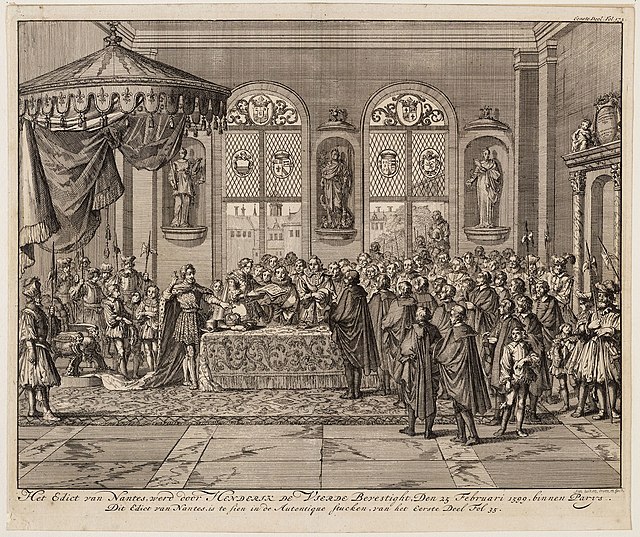
The Edict of Nantes (1598) settled the relations between Catholics and Protestants in France. In the preceding 36 years, France had gone through a series of civil wars. These wars alternated with treaties that made religious peace between Protestants and Catholics. The Edict provided the right to worship to Protestants and assigned them various fortifications in France as a safeguard. But it also limited their rights in other ways. For example, Protestants could not worship in Paris, at the royal court or in the army. The Edict of Nantes remained in force until 1685. In that year, King Louis XIV revoked the rights of Huguenots in France. The perception of the Edict of Nantes is thus divided. While it succeeded in ending decades of war, it did not diffuse the distrust between French Catholics and Protestants. Moreover, Huguenots lamented that it allowed Catholics to gain in strength and diminish the rights of Protestants in the following decades.
Did Henry’s diverse and changing life course made him more suitable as a peacemaker? Do you think a ruler should change his religion in order to become more acceptable?
Further information about the Edict of Nantes can be found at On Site, In Time.
For more information on this and other peace treaties, see