
Edict of Nantes: Commerce and religious holidays
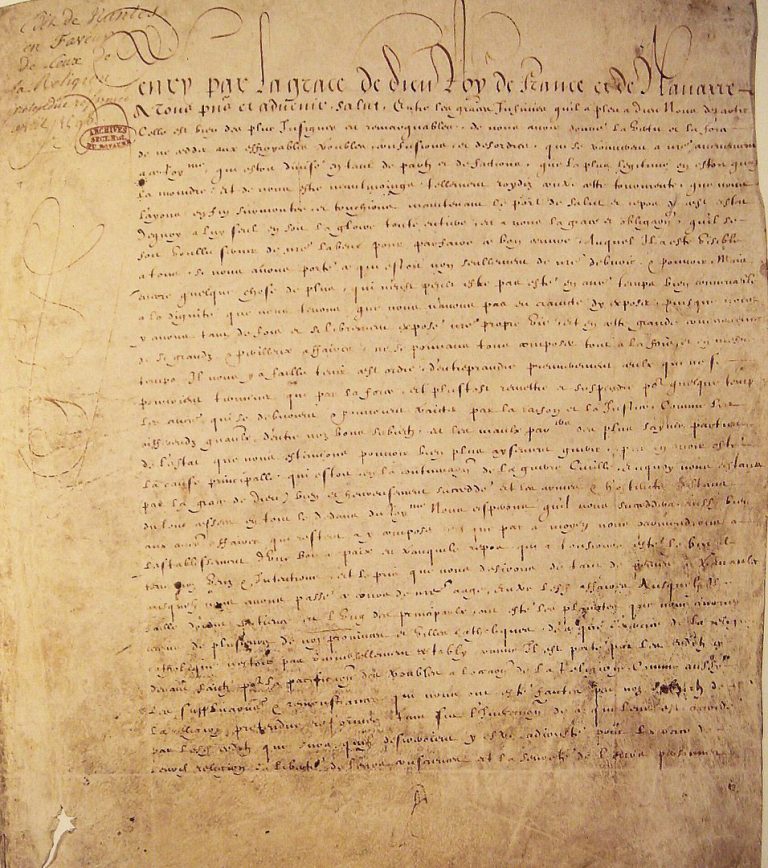
In early modern Europe, religious festivities determined the rhythm of everyday life. The celebration of Easter, the Assumption and Pentecost were important moments on the religious calendar. Protestants and Catholics shared some of these feast days, but not all. That meant that an important feast day for Catholics, such as the Assumption of Mary, was just a regular day for Protestants. The Edict of Nantes stated that Protestants should take into account such festivities of the Catholic calendar. For example, they could not open their shops on such days. Neither were they allowed to be seen working, although they could work in closed houses and without making noise. This general rule was not always strictly applied. In the French city of Loudun around 1611 for example, Protestants could openly ignore the rule. Loudon was a city with a large presence of Protestants.
The Edict of Nantes (1598) settled the relations between Catholics and Protestants in France. In the preceding 36 years, France had gone through a series of civil wars. These wars alternated with treaties that made religious peace between Protestants and Catholics.
The Edict provided the right to worship to Protestants and assigned them various fortifications in France as a safeguard. But it also limited their rights in other ways. For example, Protestants could not worship in Paris, at the royal court or in the army.
The Edict of Nantes remained in force until 1685. In that year, King Louis XIV revoked the rights of Huguenots in France. The perception of the Edict of Nantes is thus divided. While it succeeded in ending decades of war, it did not diffuse the distrust between French Catholics and Protestants. Moreover, Huguenots lamented that it allowed Catholics to gain in strength and diminish the rights of Protestants in the following decades.
Do you consider it valuable that various religions celebrate festivities in public spaces? How should those that do not belong to that religious group behave on such occasions?
Further information about the Edict of Nantes can be found at On Site, In Time.
For more information on this and other peace treaties, see