
Paris and the edict of Nantes
The Edict of Nantes allowed the celebration of Protestant worship in most cities in France. However, in Paris, the capital of the kingdom, only Catholic mass was allowed. Paris had long been a centre of opposition against rights for Protestants. The Parliament of Paris, the highest judicial court in France, had often opposed settlements that gave rights to Protestants. For example, in 1562 the court had suspended the Edict of Saint-Germain. In 1589-1590, the inhabitants of Paris had supported the Catholic League and turned against the king. King Henry III was assassinated when he prepared to besiege his radicalised capital. His successor Henry IV did not succeed in capturing Paris out of the hands of the Catholic League. The special position of Paris in the Edict of Nantes thus had a long previous history and, taking into account this history, the Edict thus reserved the French capital for Catholics.
The Edict of Nantes (1598) settled the relations between Catholics and Protestants in France. In the preceding 36 years, France had gone through a series of civil wars. These wars alternated with treaties that made religious peace between Protestants and Catholics. The Edict provided the right to worship to Protestants and assigned them various fortifications in France as a safeguard. But it also limited their rights in other ways. For example, Protestants could not worship in Paris, at the royal court or in the army.
The Edict of Nantes remained in force until 1685. In that year, King Louis XIV revoked the rights of Huguenots in France. The perception of the Edict of Nantes is thus divided. While it succeeded in ending decades of war, it did not diffuse the distrust between French Catholics and Protestants. Moreover, Huguenots lamented that it allowed Catholics to gain in strength and diminish the rights of Protestants in the following decades.
How connected are national symbols and places to particular religious groups?
Further information about the Edict of Nantes can be found at On Site, In Time.
For more information on this and other peace treaties, see
Title
Paris and the edict of Nantes
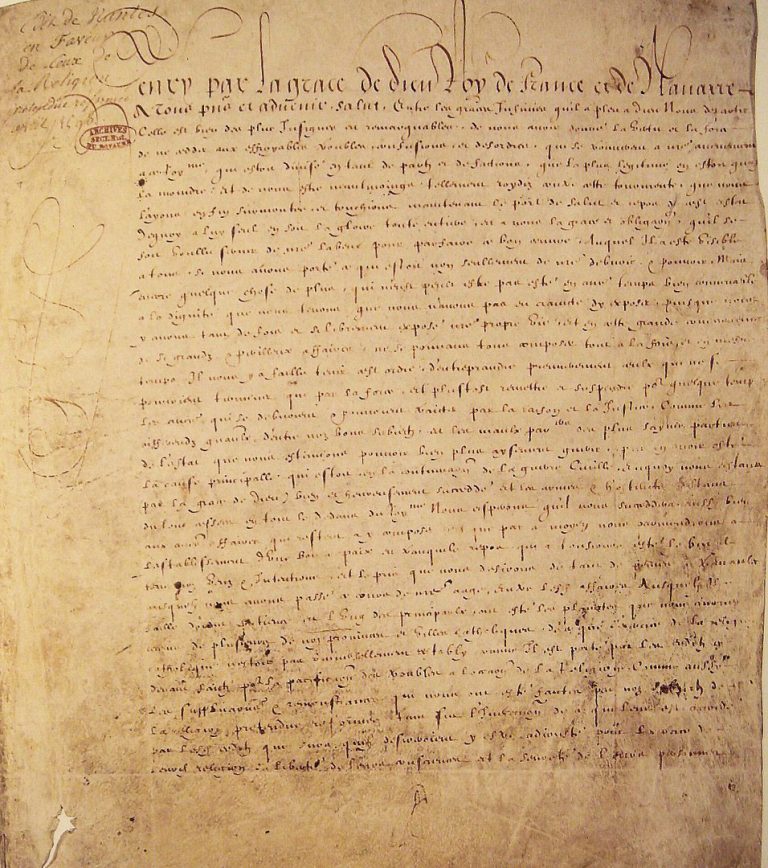
content
The Edict of Nantes allowed the celebration of Protestant worship in most cities in France. However, in Paris, the capital of the kingdom, only Catholic mass was allowed. Paris had long been a centre of opposition against rights for Protestants. The Parliament of Paris, the highest judicial court in France, had often opposed settlements that gave rights to Protestants. For example, in 1562 the court had suspended the Edict of Saint-Germain. In 1589-1590, the inhabitants of Paris had supported the Catholic League and turned against the king. King Henry III was assassinated when he prepared to besiege his radicalised capital. His successor Henry IV did not succeed in capturing Paris out of the hands of the Catholic League. The special position of Paris in the Edict of Nantes thus had a long previous history and, taking into account this history, the Edict thus reserved the French capital for Catholics.
Context
The Edict of Nantes (1598) settled the relations between Catholics and Protestants in France. In the preceding 36 years, France had gone through a series of civil wars. These wars alternated with treaties that made religious peace between Protestants and Catholics. The Edict provided the right to worship to Protestants and assigned them various fortifications in France as a safeguard. But it also limited their rights in other ways. For example, Protestants could not worship in Paris, at the royal court or in the army.
The Edict of Nantes remained in force until 1685. In that year, King Louis XIV revoked the rights of Huguenots in France. The perception of the Edict of Nantes is thus divided. While it succeeded in ending decades of war, it did not diffuse the distrust between French Catholics and Protestants. Moreover, Huguenots lamented that it allowed Catholics to gain in strength and diminish the rights of Protestants in the following decades.
Questions
How connected are national symbols and places to particular religious groups?
Temporal Coverage
16th century
Spatial Coverage
Europe, France
map
47.2181 / -1.5528
Relation
Subject
Is Referenced By
Bibliographic Citation
Mack P. Holt,The French Wars of Religion 1562–1629, Cambridge University Press, 2005
Audience
Yes
Creator
Christophe Schellekens

