
Edict of Nantes and dealing with the past
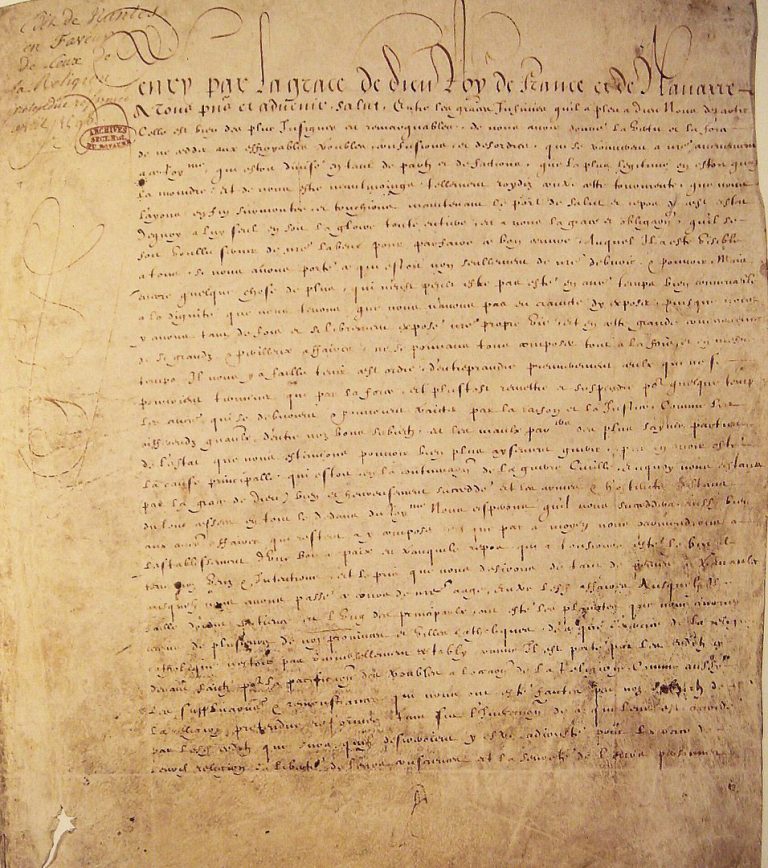
The first two articles of the edict of Nantes deal with the memory of the religious wars in France. The first article forbids prosecuting any deeds done between 1585 and 1598 that were related to the conflict. The second article prohibits discussion of any aspect of the conflict. It states that people instead have to live together as brothers, friends and co-citizens.But the past was also an important point of reference for the rights of Protestants. The edict gave them the right to worship in particular places based on regular past celebrations there. Past prosecutions also served to force community ties among Protestants. The regulation to forbid commemoration thus had particular effects. Its purpose was to prevent memories that could aggravate social conflicts. It aimed at building community ties beyond religious groups.
The Edict of Nantes (1598) settled the relations between Catholics and Protestants in France. In the preceding 36 years, France had gone through a series of civil wars. These wars alternated with treaties that made religious peace between Protestants and Catholics.
The Edict provided the right to worship to Protestants and assigned them various fortifications in France as a safeguard. But it also limited their rights in other ways. For example, Protestants could not worship in Paris, at the royal court or in the army.
The Edict of Nantes remained in force until 1685. In that year, King Louis XIV revoked the rights of Huguenots in France. The perception of the Edict of Nantes is thus divided. While it succeeded in ending decades of war, it did not diffuse the distrust between French Catholics and Protestants. Moreover, Huguenots lamented that it allowed Catholics to gain in strength and diminish the rights of Protestants in the following decades.
Do you consider forgetting previous conflicts as a solution to live together in peace? How important is it to forget or to remember?
Further information about the Edict of Nantes can be found at On Site, In Time.
For more information on this and other peace treaties, see
Title
Edict of Nantes and dealing with the past
content
The first two articles of the edict of Nantes deal with the memory of the religious wars in France. The first article forbids prosecuting any deeds done between 1585 and 1598 that were related to the conflict. The second article prohibits discussion of any aspect of the conflict. It states that people instead have to live together as brothers, friends and co-citizens.But the past was also an important point of reference for the rights of Protestants. The edict gave them the right to worship in particular places based on regular past celebrations there. Past prosecutions also served to force community ties among Protestants. The regulation to forbid commemoration thus had particular effects. Its purpose was to prevent memories that could aggravate social conflicts. It aimed at building community ties beyond religious groups.
Context
The Edict of Nantes (1598) settled the relations between Catholics and Protestants in France. In the preceding 36 years, France had gone through a series of civil wars. These wars alternated with treaties that made religious peace between Protestants and Catholics.
The Edict provided the right to worship to Protestants and assigned them various fortifications in France as a safeguard. But it also limited their rights in other ways. For example, Protestants could not worship in Paris, at the royal court or in the army.
The Edict of Nantes remained in force until 1685. In that year, King Louis XIV revoked the rights of Huguenots in France. The perception of the Edict of Nantes is thus divided. While it succeeded in ending decades of war, it did not diffuse the distrust between French Catholics and Protestants. Moreover, Huguenots lamented that it allowed Catholics to gain in strength and diminish the rights of Protestants in the following decades.
Questions
Do you consider forgetting previous conflicts as a solution to live together in peace? How important is it to forget or to remember?
Temporal Coverage
16th century
Spatial Coverage
Europe, France
map
47.0106 / 0.0844
Subject
Is Referenced By
Bibliographic Citation
Philip Benedict, ‘Shaping the Memory of the French Wars of Religion. The First centuries’, in Kuijpers, E., Pollmann, J., Müller, J., & van der Steen, J., Memory before Modernity, Brill, 2013, p 111-125
Audience
Yes
Creator
Christophe Schellekens

